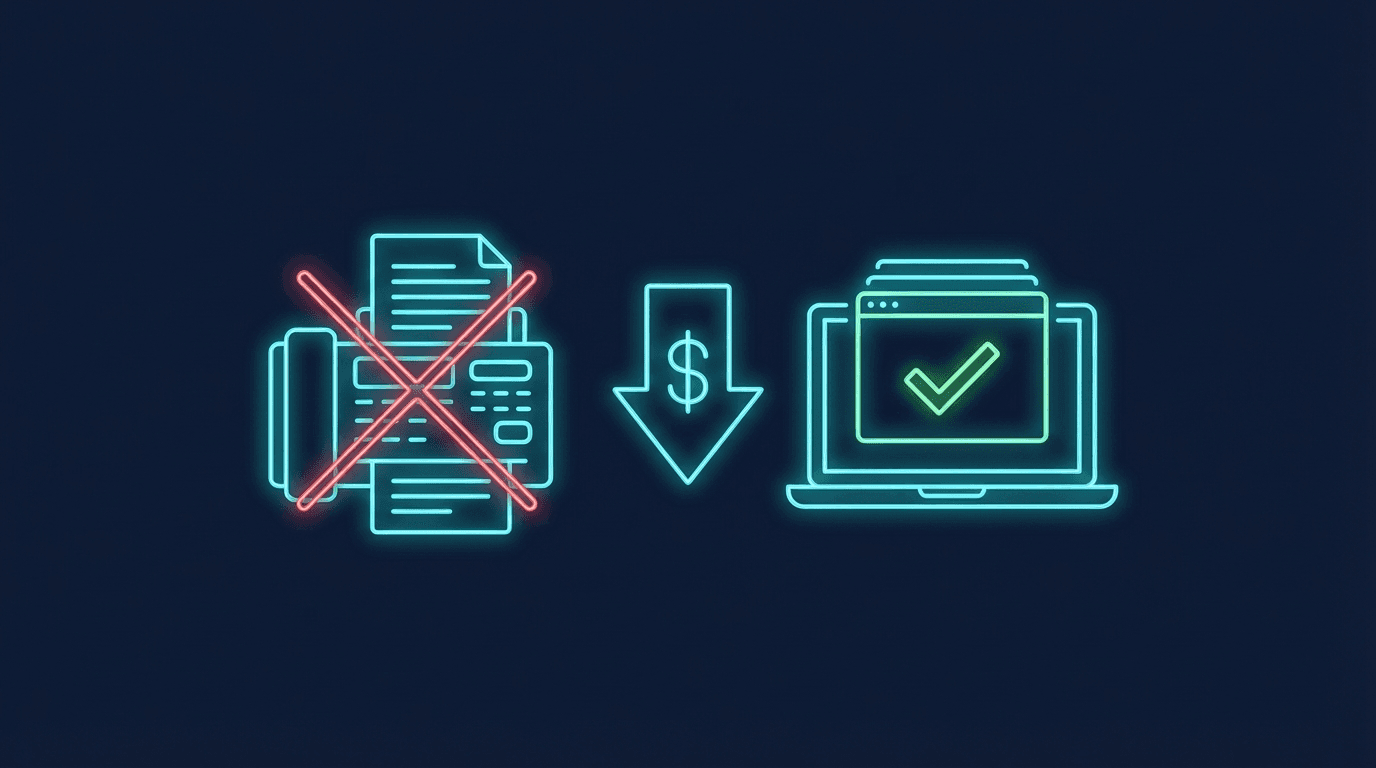
Why the Biggest Businesses Are Ditching Fax Machines: The Economics of Online Fax
The math is not close. Here is what fax machines actually cost you, and why the smartest companies already made the switch.
Faxing is not dead. Not even close.
Healthcare, legal, government, insurance, and financial institutions still use fax in document-intake workflows. The requirement comes from the receiving institution, not from a universal rule that fax is always safer or legally required.
But the machines? Those are on their way out.
The durable shift is practical: businesses can keep outbound fax capability without maintaining a machine, dedicated line, paper, toner, or shared equipment.
Here is why the economics make it obvious.
The True Cost of a Fax Machine (It Is Not What You Think)
Start with the current purchase or lease price of the machine you would actually use. Include any multifunction-device allocation in the same model.
That is the cheapest part.
The real comparison includes everything that comes after. Use your own monthly document count and page volume.
Hardware Depreciation
Divide the current purchase price by the useful life your finance policy uses. Include replacement risk when the device is no longer supported.
Dedicated Phone Line
Record the current monthly line charge, taxes, and any adapter or telecom fees. Shared lines can also create availability and routing problems.
Toner and Ink Cartridges
Use the current cartridge price and expected yield for your exact device. Apply your real print volume rather than a generic industry estimate.
Paper
Multiply your current paper cost by the pages the workflow prints, including failed attempts and internal copies.
Maintenance and Repairs
Include service contracts, replacement parts, cleaning, and unscheduled repair costs. Use current quotes for the exact equipment.
Measure staff time for preparing pages, walking to the machine, handling jams, checking status, and resolving failures. Apply your loaded labor cost.
Total Annual Cost: Traditional Fax Machine
| Cost Category | Current input | How to measure |
|---|---|---|
| Hardware (amortized) | Enter amount | Price divided by useful life |
| Dedicated phone line | Enter amount | Monthly bill times 12 |
| Toner / ink | Enter amount | Price times annual replacements |
| Paper | Enter amount | Current cost times annual use |
| Maintenance | Enter amount | Contract plus repairs |
| Staff time | Enter amount | Hours times loaded rate |
| TOTAL | Add inputs | Annual machine cost |
Convert the annual total to a monthly figure. For multiple locations or departments, model each machine and line separately.
Done with fax machine costs? Send your next fax from your browser from your browser. Free tier available.
Try FaxDrop FreeThe Cost of Online Fax
Per-Page Pricing (Most Online Fax Services)
Some online fax services meter pages. Verify the current billing unit, included allowance, overage rate, and whether sent and received pages count differently.
The problem with per-page pricing: costs scale directly with document length. A 20-page medical record costs twice as much as a 10-page one. For healthcare, legal, and insurance offices sending multi-page documents all day, the pages add up fast.
Per-Fax Pricing (The FaxDrop Model)
FaxDrop uses credits for paid sending. One purchased or subscription credit covers one outbound fax up to 10 uploaded pages. Send a 1-page cover letter or a 10-page contract: same paid credit. No subscription is required for purchased credits, with no monthly commitment, no paying for pages you never send.
For businesses that send multi-page documents, this is a meaningful difference. A law office faxing a 10-page filing uses one purchased or subscription credit. A medical practice sending an 8-page patient record also uses one paid credit. Compare that with the current total from any page-metered provider.
An outbound browser workflow removes sender-side hardware, phone-line, paper, toner, and maintenance costs. Staff time still varies by document preparation, verification, status review, and exception handling.
Subscription Model (Best for High Volume)
Subscription structures differ by provider. Verify current included usage, overages, inbound numbers, team controls, renewal, and cancellation terms before modeling a recurring plan.
The Head-to-Head Comparison
| Traditional Machine | Online (Pay-Per-Fax) | Online (Subscription) | |
|---|---|---|---|
| Annual cost | Enter current total | Current unit price times usage | Current plan plus overages |
| Monthly cost | Annual total divided by 12 | Actual monthly usage | Plan plus current overages |
| Setup cost | Current hardware and activation | Verify current terms | Verify current terms |
| Phone line required | Usually required | No | No |
| Works from anywhere | No (office only) | Yes | Yes |
| Workflow time | Measure preparation and handling | Measure preparation and review | Measure preparation and review |
The result depends on your current setup, volume, document length, staffing, and the provider terms you verify.
Real-World Scenarios
Scenario 1: The Solo Law Office
Model the office's monthly court filings, client documents, and correspondence.
Traditional: Add current machine, line, toner, paper, maintenance, and staff-time costs.
Page-metered online service: Enter the current unit price, included allowance, overages, and actual page volume.
Per-fax with FaxDrop: Most court filings are multi-page. If those 50 pages are 10 fax jobs averaging 5 pages each, that is 10 paid credits per month. Purchased credits require no subscription, and each covers one outbound fax up to 10 uploaded pages.
Compare the resulting annual totals and document the assumptions behind them.
Scenario 2: The Medical Practice
Model the practice's patient records, insurance forms, referrals, and prescriptions.
Traditional: Add current commercial equipment, line, supplies, maintenance, and loaded staff-time costs.
Online: Verify the current plan, overages, account controls, retention, and every vendor agreement in the workflow.
Compare total cost only after the healthcare workflow review. FaxDrop uses a fax carrier with a signed BAA, while broader vendor BAA coverage remains under review. See the HIPAA compliance guide before sending protected health information.
Scenario 3: The Multi-Location Business
Model each office location, machine, line, and authorized sender separately.
Traditional: Add current machines, lines, supplies, maintenance, and support time across every site.
Online: Verify current account, inbound-number, team-access, support, and pricing terms. FaxDrop supports outbound sending only.
Compare the annual totals and confirm the access model meets each site's needs.
Beyond the Money: What the Numbers Do Not Show
The cost comparison alone makes the case. But there are factors the spreadsheet misses.
Document handling. A traditional fax machine can leave documents in an open tray. Anyone walking by may see them. That creates a healthcare privacy risk that organizations must address with physical safeguards. Online outbound fax removes the sender-side print tray, but still requires vendor, device, account, and file-handling review.
Remote work compatibility. A fax machine lives in one physical location. Online fax works from a laptop in a home office, a phone in a taxi, or a tablet in a hospital room. In 2026, tying critical business communication to a single physical device in a single room is a liability, not a feature.
Operational simplicity. Online fax removes sender-side paper jams, toner, and shared-machine queues. Busy destinations and unresolved carrier outcomes can still occur, so check the current status and do not blindly resend.
Environmental impact. No paper waste, no toner cartridge disposal, no electricity draw from always-on hardware. For companies with sustainability commitments, eliminating fax machines is a straightforward win.
Scalability. Browser workflows can remove a single-machine queue. Capacity, rate limits, destination availability, and carrier outcomes still vary.
Who Is Still Holding On (and Why They Should Not Be)
The industries that fax the most are the same ones that benefit the most from switching.
Healthcare: Healthcare organizations may prefer online outbound fax to remove shared sender-side print trays. HIPAA suitability still depends on the complete workflow and vendor agreements.
Legal: Courts may publish fax submission procedures. Follow the specific court rules and preserve the current supported transmission status with your records.
Government: The IRS, state agencies, and local offices still accept and sometimes require fax. Online fax services can send to government fax numbers and provide a transmission status. The receiving agency's instructions control what satisfies a filing requirement.
Financial services: Banks, insurance companies, and mortgage processors exchange sensitive documents via fax. Compare current provider documentation, agreements, access controls, retention, status semantics, and account safeguards before choosing a service.
The Bottom Line
A machine workflow includes hardware, phone-line, supplies, maintenance, and labor.
An online workflow replaces those inputs with current credits, plans, and overages.
Run the comparison with your actual documents and verified provider terms.
The operational case can be as important as price. Browser sending removes sender-side hardware while preserving the recipient's fax endpoint.
The fax is not going away. The machine is.
Ready to drop the machine? FaxDrop lets you send a fax from your browser. No machine, subscription, or sender-side phone line is required. FaxDrop provides 2 free sends per month, up to 5 total pages each including the cover page.
Send a Fax NowFAQs
Frequently Asked Questions
How much does a traditional fax machine cost per year?+
Add the current hardware, phone line, toner, paper, maintenance, and staff-time costs for your own operation. The total varies by vendor and volume.
How much cheaper is online fax compared to a fax machine?+
It depends on your current machine costs, document lengths, and sending volume. Compare those costs with each online provider's current billing unit and plan terms.
Do I still need a phone line for online fax?+
An outbound online fax workflow does not require the sender to maintain a dedicated fax line. Confirm any separate inbound number requirements before replacing equipment.
Can online fax support healthcare workflows?+
Yes. Online fax can support healthcare workflows when vendor agreements, access controls, audit trails, and data-handling rules fit the use case. FaxDrop uses a fax carrier with a signed BAA. Broader vendor BAA coverage remains under review, so request current documentation before sending PHI.
Can I send a fax online without a subscription?+
Yes. FaxDrop provides 2 free sends per month, up to 5 total pages each including the cover page. Purchased credits and optional subscriptions support larger or recurring outbound jobs.
Frequently Asked Questions
How much does a traditional fax machine cost per year?
Add the current hardware, phone line, toner, paper, maintenance, and staff-time costs for your own operation. The total varies by vendor and volume.
How much cheaper is online fax compared to a fax machine?
It depends on your current machine costs, document lengths, and sending volume. Compare those costs with each online provider's current billing unit and plan terms.
Do I still need a phone line for online fax?
An outbound online fax workflow does not require the sender to maintain a dedicated fax line. Confirm any separate inbound number requirements before replacing equipment.
Can online fax support healthcare workflows?
Yes. Online fax can support healthcare workflows when vendor agreements, access controls, audit trails, and data-handling rules fit the use case. FaxDrop uses a fax carrier with a signed BAA. Broader vendor BAA coverage remains under review, so request current documentation before sending PHI.
Can I send a fax online without a subscription?
Yes. FaxDrop provides 2 free sends per month, up to 5 total pages each including the cover page. Purchased credits and optional subscriptions support larger or recurring outbound jobs.